

Showcase: Engineering an Automated n8n-Powered Knowledge Ingestion

Information velocity within technical industries is a critical bottleneck. Staying competitive means ingesting, processing, and retaining vast amounts of data from divergent sources—including technical research papers (PDFs), engineering blogs (RSS feeds), and ad-hoc team updates (Telegram). Manual synthesis is too slow.

Our firm was tasked with developing a unified, intelligent system to ingest this information, normalize it, and apply sophisticated AI processing to generate structured knowledge assets (flashcards and summaries) automatically.

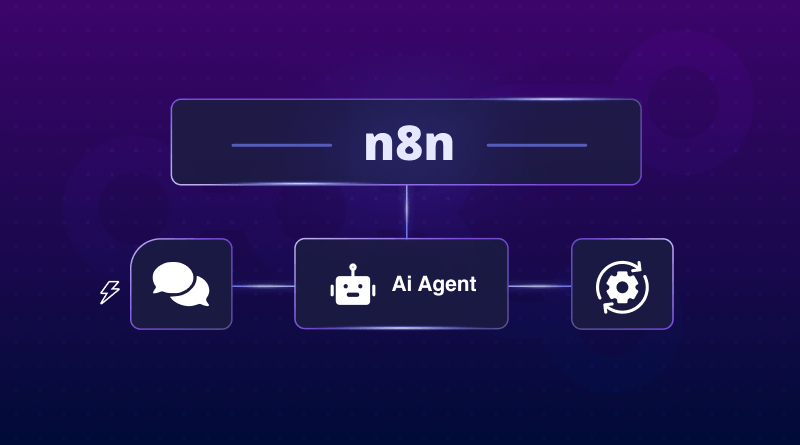
We selected n8n as the workflow orchestration engine for this project due to its flexibility in combining diverse APIs, robust conditional logic, and seamless integration with emerging LLM (Large Language Model) stacks.

The Architecture: A Unified Ingestion & Synthesis Engine

Below is the complete architectural diagram of the solution we engineered. This complex, multi-layered workflow automates the entire knowledge management lifecycle, from raw data acquisition to structured storage and notification.
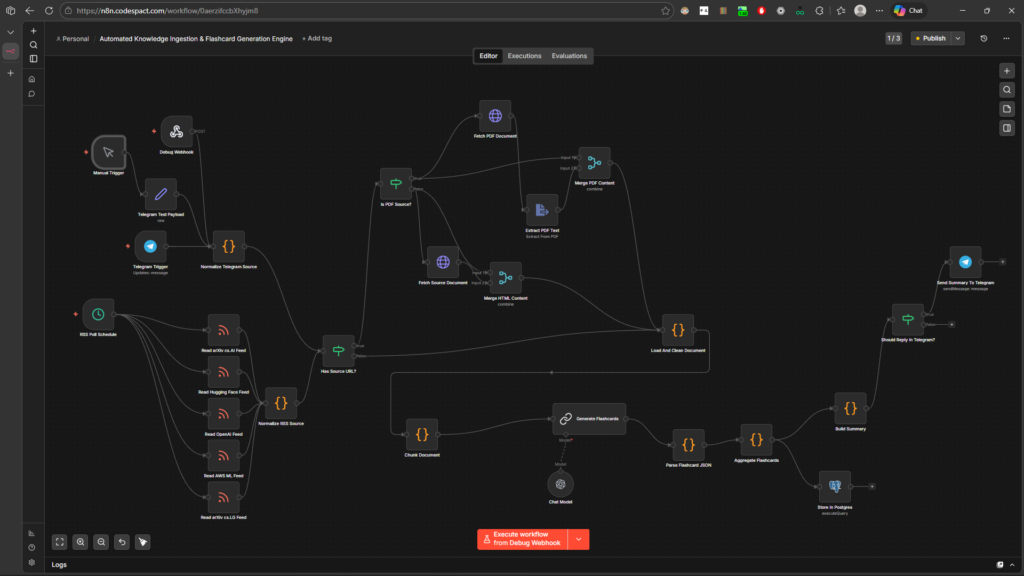


This workflow is structured into four main operational phases:

Phase 1: Diversified Ingestion and Trigger Management

A robust pipeline must accept data on different schedules and from different contexts. We implemented multiple entry points:

  • Scheduled Technical Feeds (Cron): The workflow automatically pulls updates on a schedule from key technical sources, including Hugging Face Feed, Arxiv CS AI Feed, OpenAI Blog Feed, AWS ML Blog Feed, and Arxiv CS LG Feed.
  • Ad-Hoc Team Input (Telegram): Engineering teams can forward relevant articles or snippets directly to a monitored Telegram Bot, immediately triggering the ingestion process.
  • Manual & Webhook Triggers: Essential for developer testing, integration testing, and debugging.

Phase 2: Data Normalization and Content Harvesting (ETL)

A significant challenge in this project was data heterogeneity. A Telegram payload is structured differently than an RSS entry, and extracting text from a web article requires a different approach than extracting text from a complex scientific PDF. We implemented an ETL (Extract, Transform, Load) logic layer:

  1. Normalization Nodes: The raw input from Telegram or RSS feeds passes through normalization nodes to create a standardized data object for the core processing engine.
  2. Conditional Routing: The workflow intelligently determines the content type (Has Source URL? -> Is PDF Source?).
  3. PDF Harvesting: If the source is a research paper, the workflow utilizes specialized nodes (Fetch PDF Document and Extract PDF Text) to harvest the content, filtering out unnecessary metadata.
  4. HTML/Text Harvesting: For articles and blog posts, it fetches and parses the HTML content (Fetch Source Document and Extract Text Content).

Phase 3: AI-Driven Analysis and Flashcard Generation (RAG Pattern)

The core value proposition of this system is the intelligent synthesis of information. We didn’t just feed raw text into an LLM; we engineered a robust processing chain:

  • Load and Clean Document: The extracted text is sanitized to remove noise and formatted for analysis.
  • Vector Retrieval (RAG): The sanitized text is fed through a RAG (Retrieval-Augmented Generation) chain. It is chunked (Chunk Document) and then cross-referenced against a vector store (Fetch Relevant Snippets). This ensures the AI model operates with precise context.
  • Flashcard Synthesis (Structured Output): A tailored prompt is sent to the AI chat model to synthesize the information specifically into high-quality flashcards (question/answer format). A crucial engineering step was implemented here: forcing the LLM to output valid JSON (Parse Flashcard JSON), ensuring it can be reliably used in downstream applications.
  • AI Summary: Simultaneously, a second prompt generates a high-level technical summary of the entire source.

Phase 4: Closing the Loop – Persistance and Notification

The pipeline concludes by persisting the data and providing immediate value to the team:

  • Data Aggregation: The synthesized flashcards from the JSON parser are collected into a clean array.
  • Postgres Storage: All structured assets (source metadata, original text, flashcards, and summary) are committed to a relational database (Store in Postgres).
  • Conditional Telegram Notification: The workflow checks if the trigger was an ad-hoc team submission (Should Reply in Telegram?). If so, the bot immediately replies with the AI-generated summary and a count of the new flashcards generated, providing instant confirmation and synthesis to the user.

Conclusion and Impact

This showcase piece demonstrates advanced proficiency in integrating disparate systems, handling heterogeneous data at scale, and implementing complex AI workflows beyond simple API calls. By moving from manual content consumption to an automated, RAG-enabled ETL process, we have built a system that turns the velocity of technical information from a challenge into a sustainable competitive advantage.

Leave a Reply

Your email address will not be published. Required fields are marked *

Commonly asked questions and answers

Phone:

+44 7926 690028

Email:

contact@codespact.com

What does your system engineering and consulting involve?

Before writing code, we start with a deep technical diagnosis. We analyze your entire infrastructure, software, and daily operations to identify risks and real opportunities for system improvement.

Based on the initial diagnosis, we design a clear architecture and a realistic technical roadmap. Every single decision considers stability, scalability, and compatibility with your ongoing operations. We never apply generic fixes to complex tech systems.

Finally, we execute structural changes in a controlled and documented manner, strictly aligned with your internal teams. Execution is just a part of the process, not the end. We provide continuous tech support to ensure full platform adoption, smooth continuity, and the absolute capacity for future evolution.

We focus on the complexity of your systems rather than just the size of your company. We partner with organizations that already have running operations but face technical limits due to fast growth.

Often, companies scale their operations rapidly without establishing a solid technical architecture. They end up dealing with accumulated technical debt, unscalable software, or critical infrastructure that is simply too difficult and costly to maintain.

Whether you are a mid-sized team or a large enterprise, our tech interventions are always progressive and highly conscious. We deeply respect your ongoing processes and existing teams. Our main objective is to enable true technical evolution without ever putting your daily operational continuity at risk.

Yes, we frequently intervene in existing platforms that suffer from accumulated technical debt.

Before any intervention, we completely analyze the entire system: your infrastructure, software, and processes. This allows us to spot operational risks and find the safest path to refactor your tech debts.

Our interventions are always progressive and highly conscious. We redesign the architecture and implement structural improvements without ever risking your daily operational continuity.

We never rely on generic tools. Our tech stack is chosen based on your specific system needs. We utilize cloud infrastructure, robust software frameworks, and automated deployments to ensure solid stability.

We build robust backend architectures with Python and Laravel, and scalable applications using React Native. Our cloud infrastructure is strictly powered by Docker, Kubernetes, and GCP to ensure high availability.

For complex data and AI, we leverage TensorFlow and NLP models. Every tool is implemented with strict operational control and continuous support.

Yes, we do. In codesPACT, execution is merely a part of the process, not the end. We provide continuous tech support to ensure your systems evolve with absolute stability, proper control, and a clear technical direction long after the initial deployment phases.

We accompany the transition to assure full adoption, continuity, and future evolution capacity. We do not just deliver the system; we make sure that your internal teams operate it securely.

This approach allows real improvements without generating unnecessary dependencies. Our ongoing role is to act as your technical partner for strategic decisions.

Newsletter subscribe!

Enter your email to unlock our exclusive IT insights on professional systems architecture tailored to your business needs.

Have tech questions?

Let’s schedule a short call to discuss how we can work together and contribute to the stability of your tech ecosystem.